Additional Programs
Home • Additional Programs
Page Navigation
Mold Information
Michigan Department of Health and Human Services, Toxins and Health Hotline
1-800-648-6942
What Are Molds?
What are molds?
Molds are microscopic fungi that live on plant or animal matter. No one knows how many species of fungi exist, but estimates range from tens of thousands to perhaps three hundred thousand or more. Most are filamentous organisms and the production of spores is characteristic of fungi in general. These spores can be air-, water-, or insect-borne.
What Are Some of the Common Indoor Molds?
Cladosporium, penicillium, alternaria, aspergillus, and mucor.
How Do Molds Affect people?
Some people are sensitive to molds. For these people, exposure to molds can cause symptoms such as nasal stuffiness, eye irritation, or wheezing. Some people, such as those with serious allergies to molds, may have more severe reactions. Severe reactions may occur among workers exposed to large amounts of molds in occupational settings, such as farmers working around moldy hay. Severe reactions may include fever and shortness of breath. People with chronic illnesses, such as obstructive lung disease, may develop mold infections in their lungs.
Where Are Molds Found?
Molds are found in virtually every environment and can be detected, both indoors and outdoors, year-round. Mold growth is encouraged by warm and humid conditions. Outdoors they can be found in shady, damp areas or places where leaves or other vegetation are decomposing. Indoors they can be found where humidity levels are high, such as in basements or showers.
What Areas Have High Mold Exposures?
- Antique shops
- Greenhouses
- Saunas
- Farms
- Mills
- Construction Areas
- Flower Shops
- Summer Cottages
How Can People Decrease Mold Exposure?
Sensitive individuals should avoid areas that are likely to have mold, such as compost piles, cut grass, and wooded areas. Inside homes, mold growth can be slowed by keeping humidity levels below 40 percent and ventilation showers and cooking areas. Mold growth can be removed with commercial products or a weak bleach solution (1 cup of bleach in 1 gallon of water). In situations where mold exposure is unavoidable, sensitive people should wear a tight-fitting face mask.
Specific Recommendations
- Repair any water leaks.
- Keep the humidity level in the house below 40 percent.
- Use an air conditioner or a dehumidifier during humid months.
- Be sure the home has adequate ventilation, including exhaust fans in kitchen and bathrooms.
- Add mold inhibitors to paints before application.
- Clean bathrooms with mold killing products.
- Do not carpet bathrooms and basements.
- Remove or replace previously soaked carpets and upholstery.
Additional information on fungi and fungal disease visit:
For more information contact your local health department.
Shiawassee County Health Department Environmental Division
201 N. Shiawassee St.
Corunna, Michigan 48817
Chronic Wasting Disease
Chronic Wasting Disease is a fatal neurodegenerative illness affecting deer, elk, and moose.
Emerging Diseases
Information on Bats and Rabies
Landlord/Tenant Disputes
Legal Services
Legal Services of South Central MI (734) 665-6181
Legal Aid of Central MI (517) 394-3121
Legal Hotline for MI Seniors (800) 347-5297
Dispute Resolution Center of Central MI (517) 485-2274
Lead
The Shiawassee County Health Department screens, identifies and refers children with lead poisoning to their medical provider for treatment. Public health nurses provide follow-up for children with high lead levels in cooperation with medical providers. We also perform blood lead screenings for adults upon request.
Mercury
Methamphetamine Labs
Radon
Tick Information
Ticks may carry diseases that cause illness in humans and animals. The Michigan Department of Health and Human Services (MDHHS) provides tick and identification at no charge to Michigan residents. Ticks that are dead when they are received will not be tested. Ticks may also be identified electronically by submitting a photo .
Avoiding Ticks
Although tick exposure can occur year-round, the most active months are April to September. It’s important to know where to expect ticks in your area and how to treat your clothing and gear. Ticks are known to live in grassy, brushy, wooded areas, or even on animals. When spending time outdoors during the summer months take precaution when walking your dog, camping, gardening, or hunting and look for ticks when you return home. Using insect repellant with DEET can be applied to clothing and skin.
When you come indoors, check your clothing for ticks. Ticks may be carried into your home on your clothing or through your pet. If you find any ticks, they should be removed. If you need to wash your clothes, do so in hot water or tumble dry your clothes for at least 10 minutes to kill ticks. Showering within two hours after coming indoors can reduce the risk of Lyme Disease and other tickborne diseases.
When conducting a full body check, use a full-length mirror to view all parts of your body. Check yourself and your child(ren) for ticks:
- Under the arms
- In and around the ears
- Inside the belly button
- Back of the knees
- In and around the hair
- Between the legs
- Around the waist
When checking your pet for ticks, look:
- In and around the ears
- Around the eyelids
- Around the tail
- Under the collar
- Under the front legs
- Between the back legs
- Between the toes
What Type of Clothing Should I Wear Outside?
Tuck shirt into pants and pants into long socks. This can prevent a tick from crawling under clothing. Wear a hat and kerchief to protect your head and neck from ticks.
- Long, light colored pants
- Long sleeved shirt
- Closely knitted socks
- Kerchief and hat
Tick Removal
According to the CDC:
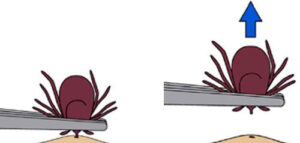
- Use fine-tipped tweezers to grasp the tick as close to the skin’s surface as possible.
- Pull upward with steady, even pressure. Don’t twist or jerk the tick; this can cause the mouth-parts to break off and remain in the skin. If this happens, remove the mouth-parts with tweezers. If you are unable to remove the mouth easily with clean tweezers, leave it alone and let the skin heal.
- After removing the tick, thoroughly clean the bite area and your hands with rubbing alcohol or soap and water.
- Never crush a tick with your fingers. Dispose of a live tick by putting it in alcohol, placing it in a sealed bag/container, wrapping it tightly in tape, or flushing it down the toilet.
- See below for proper tick removal:
2019 Lyme Disease Map
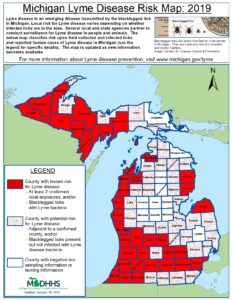
Below is the 2019 Lyme Disease Map provided by the Michigan Department of Health and Human Services. This map was updated in January 2019. For more information about Lyme Disease prevention, visit www.michigan.gov/lyme.